April 28, 2026
 5214 Views
QuickBooks Salesforce Integration in 2026: Methods, Architecture, and Best Practices


QuickBooks Salesforce integration connects the system where sales teams manage customers and opportunities with the accounting platform where finance manages invoices, payments, expenses, and financial records. With QuickBooks trusted by 10 million businesses worldwide and Salesforce holding 20% of the global CRM market, connecting the two platforms is a common requirement for growing companies.
The value is straightforward: finance should not need to re-enter Salesforce data in QuickBooks, and sales should not need to ask finance whether an invoice has been issued or paid. The real challenge is choosing the right integration architecture. A standard connector may work for simple quote-to-cash workflows, while custom objects, complex billing logic, multiple QuickBooks companies, or strict reconciliation requirements often require a more advanced approach.
Peeklogic helps companies design these integrations around data ownership, field mapping, APIs, middleware, error handling, monitoring, and Salesforce automation.
Need a Reliable Salesforce + QuickBooks Integration?
Explore Integration ServicesWhat Is QuickBooks Salesforce Integration?
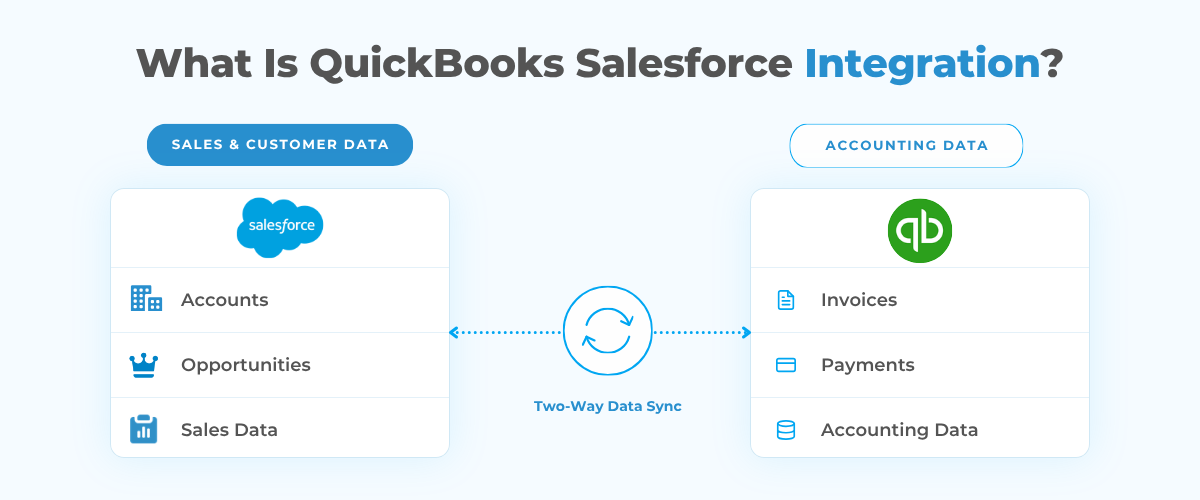
Salesforce and QuickBooks integration synchronizes selected CRM and accounting records so sales, finance, operations, and customer-facing teams can work from consistent information.
Salesforce usually remains the system of record for leads, accounts, contacts, opportunities, products, sales activity, and pipeline. QuickBooks remains authoritative for accounting records such as invoices, payments, credit memos, expenses, taxes, and financial balances.
The goal is not to copy every field between both platforms. A reliable integration defines which system owns each record and which downstream teams need visibility.
A common workflow looks like this:
- A sales rep marks an Opportunity as Closed Won in Salesforce.
- The integration validates the customer, products, quantities, discounts, tax data, and billing details.
- A customer and invoice are created or updated in QuickBooks.
- QuickBooks remains responsible for the accounting transaction.
- Invoice number, balance, due date, payment status, or other approved financial fields sync back to Salesforce.
- Sales and customer success can see account status without asking finance to check another system.
This is where QuickBooks Salesforce sync creates real value. It reduces duplicate entry without turning the CRM into an accounting ledger.
What Data Should Salesforce and QuickBooks Sync?
The first architecture decision is data ownership.
| Business Data | Recommended Source of Truth | Typical Sync Direction | Why |
|---|---|---|---|
| Accounts / customers | Depends on operating model | Salesforce → QuickBooks or two-way | Prevent duplicate customers |
| Contacts | Salesforce | Salesforce → QuickBooks when required | Keep CRM relationship data authoritative |
| Products / items | Often QuickBooks or master catalog | QuickBooks → Salesforce or governed two-way | Avoid mismatched SKUs and prices |
| Opportunities | Salesforce | Usually no direct QuickBooks ownership | CRM owns pipeline |
| Estimates / quotes | Depends on quoting process | Salesforce → QuickBooks | Supports quote-to-cash |
| Invoices | QuickBooks | QuickBooks → Salesforce after creation | Finance owns accounting records |
| Payments | QuickBooks | QuickBooks → Salesforce | Gives sales visibility without changing books |
| Credit memos | QuickBooks | QuickBooks → Salesforce | Keeps corrections governed by finance |
| Balances / aging | QuickBooks | QuickBooks → Salesforce | Helps account teams manage renewals and collections |
The exact model depends on the company. Some businesses maintain their product catalog in Salesforce because CPQ controls pricing. Others treat QuickBooks Items as the financial master.
The important rule is that the same business field should not have two uncontrolled owners. If both systems can update customer names, product codes, tax information, or invoice values independently, conflicts are inevitable.
What Are the Main Ways to Integrate Salesforce with QuickBooks?
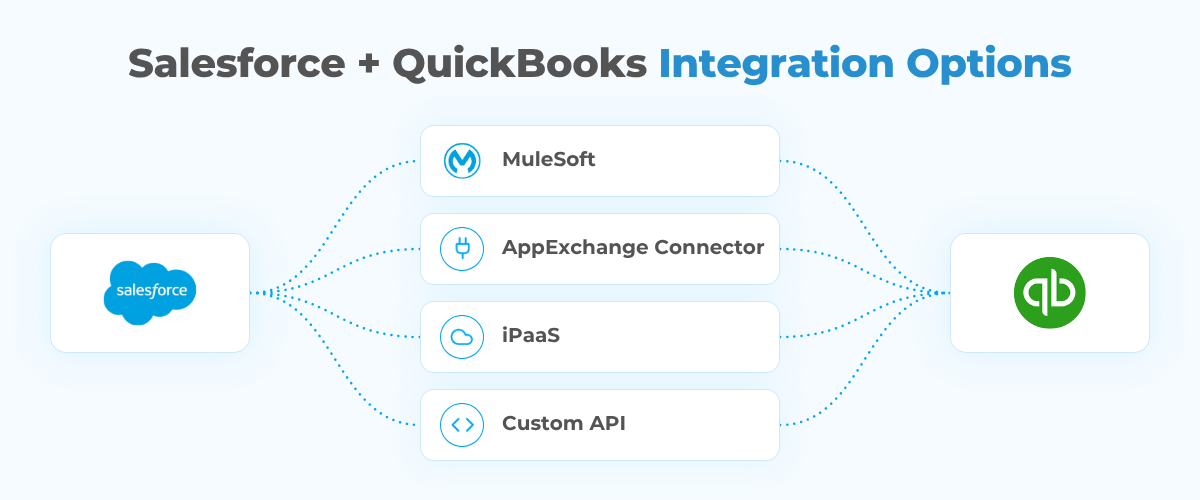
There is no single best Salesforce QuickBooks connector for every company. In 2026, the realistic options fall into four groups.
1. Salesforce and MuleSoft
Salesforce’s current QuickBooks integration guidance recommends MuleSoft for connecting the two platforms.
This approach fits organizations already using Salesforce integration tools or companies that expect QuickBooks to be one of several systems connected to CRM.
MuleSoft can support accounting workflows involving customers, invoices, items, estimates, and payments. The MuleSoft QuickBooks Online connector documentation provides the available triggers and actions for these records.
The main advantage is architecture consistency. Salesforce, QuickBooks, ERP tools, support platforms, and other applications can use the same integration layer instead of relying on separate point-to-point scripts.
MuleSoft is especially useful when you need orchestration, reusable connections, monitoring, or several connected systems. For a very small one-way workflow, it may be more infrastructure than necessary.
2. AppExchange Connectors
Another option is a purpose-built Salesforce QuickBooks connector available through Salesforce AppExchange.
Current solutions include QuickBooks-focused products such as Breadwinner and broader integration platforms such as Commercient. Depending on the product, they can provide customer synchronization, invoice and payment visibility inside Salesforce, product or item synchronization, and one-way or two-way data flows.
This route can be attractive when business requirements closely match what the package already supports.
Before selecting a connector, check more than the feature list. Confirm whether it supports:
- QuickBooks Online or QuickBooks Desktop
- Your Salesforce edition
- Custom Salesforce objects
- Custom fields
- Multiple QuickBooks companies
- Required transaction volumes
- One-way or two-way synchronization
- Error handling and monitoring
- Your specific invoice and payment workflows
The lower implementation effort can be valuable, but only when the connector matches the process.
3. iPaaS and Workflow Automation
Platforms such as Workato, Boomi, Celigo, or similar integration tools can sit between Salesforce and QuickBooks.
This model works well when a company already has an iPaaS strategy and wants to centralize integrations outside Salesforce. It can also support transformations, branching logic, approvals, retries, and connections to additional systems.
For example, a Closed Won opportunity might first pass through an approval check, then create a QuickBooks customer, generate an invoice, notify finance, and write the invoice ID back to Salesforce.
The tradeoff is operational ownership. Someone still needs to maintain recipes or flows, monitor failures, manage credentials, and update mappings when either platform changes.
4. Custom API Integration
Custom Salesforce integration provides the most control.
A custom architecture can use Salesforce APIs, Apex, Platform Events, Flow, middleware, and QuickBooks APIs to implement business-specific logic.
Typical reasons for choosing this route include:
- Multiple legal entities
- Complex billing rules
- Custom Salesforce objects
- Unusual product structures
- Advanced approval requirements
- High transaction volumes
- Custom reconciliation logic
- Strict audit requirements
Custom does not automatically mean better. If a standard connector covers 95% of the requirement, writing and maintaining code may create unnecessary cost.
The decision should be based on process complexity rather than preference for one technology.
Which Salesforce QuickBooks Integration Option Should You Choose?
A useful approach is to match integration complexity to architecture.
| Option | Best Fit | Main Strength | Main Limitation |
|---|---|---|---|
| MuleSoft | Multi-system Salesforce environments | Governed integration platform | Can be excessive for one simple workflow |
| AppExchange connector | Standard QuickBooks + Salesforce processes | Faster deployment | Limited by supported mappings and product design |
| iPaaS | Companies already using an integration platform | Flexible orchestration | Requires external platform ownership |
| Custom API | Complex or highly specific requirements | Maximum control | Higher build and maintenance responsibility |
Do not choose only on subscription price.
Compare total cost of ownership, including implementation, testing, error handling, support, monitoring, upgrades, and the amount of manual finance work that remains after launch.
Our guide to evaluating the ROI of a Salesforce custom integration provides a framework for comparing these costs against time saved, error reduction, faster processing, and improvements in customer experience.
How to Design a Reliable QuickBooks Salesforce Integration
The technical connector is only one part of the project.
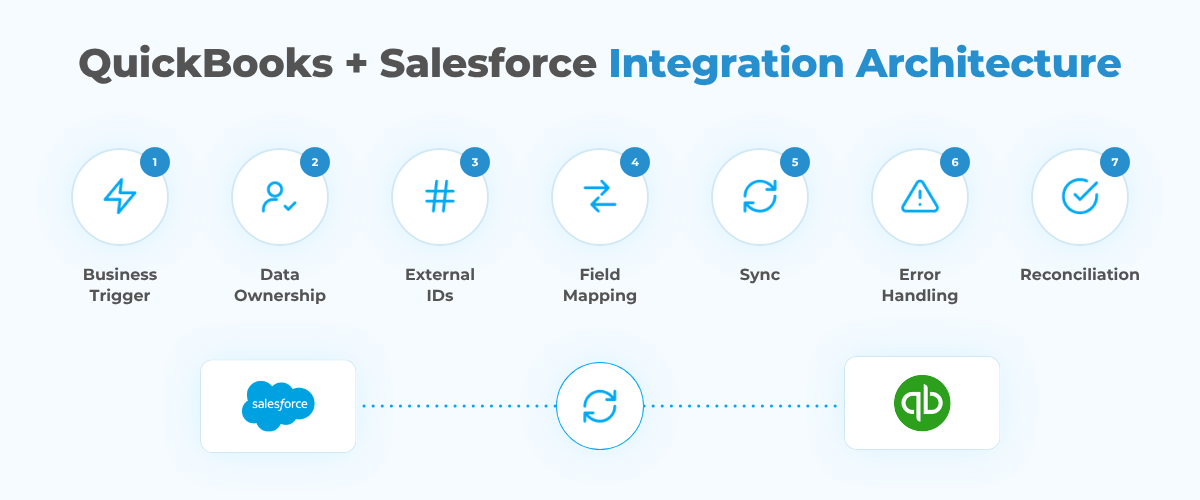
Start by mapping the business event that should trigger the integration.
“Sync Salesforce and QuickBooks” is too broad.
“Create an approved QuickBooks invoice after a Salesforce Opportunity reaches Closed Won and passes finance validation” is specific enough to design and test.
Then define stable identifiers. Each shared customer, invoice, product, or payment should have a reliable external ID so the integration knows whether to create a new record or update an existing one.
Next, document field mappings. Include required fields, data types, transformations, picklist values, currencies, tax rules, and null-value behavior.
Error handling is equally important.
If QuickBooks rejects an invoice because the customer is missing or a required accounting value is invalid, the integration should not fail silently. The team needs an error record, understandable message, retry process, and clear owner.
Finally, design reconciliation.
A successful API response does not prove that Salesforce and QuickBooks will remain aligned indefinitely. Finance should be able to compare record counts, invoice totals, failed transactions, and outstanding mismatches.
This follows the same principles we discuss in our Salesforce ERP integration guide: define systems of record, shared identifiers, sync direction, and correction logic before development begins.
How to Implement the Integration Step by Step
A practical Salesforce to QuickBooks integration should move through a controlled sequence rather than connecting production systems immediately.
First, document the current quote-to-cash workflow and identify where employees re-enter data today.
Second, agree on the systems of record and the external IDs used to match customers, products, invoices, and payments.
Third, build the field map and define transformations, required values, and validation rules.
Fourth, choose the integration pattern and test it in Salesforce Sandbox and a QuickBooks test environment where possible.
Fifth, test exceptions such as duplicate customers, failed invoices, voids, credits, partial payments, and updated Opportunities.
Finally, launch with monitoring and reconciliation already in place.
During the first weeks after go-live, review failed transactions and mismatches frequently. Integration quality is not only about whether records move. It is about whether teams can detect, explain, and correct problems before they affect customers or financial reporting.
QuickBooks Online vs QuickBooks Desktop
QuickBooks Online Salesforce integration is generally easier because the cloud product exposes modern APIs and is directly supported by cloud integration platforms.
QuickBooks Desktop creates a different architecture. Depending on the Salesforce QuickBooks connector, it may require a local agent, hosted bridge, scheduled synchronization, or another vendor-specific integration layer.
That difference matters during vendor selection.
A connector supporting QuickBooks Online does not automatically support QuickBooks Desktop in the same way.
If your company plans to migrate from Desktop to Online, decide whether it makes sense to integrate the existing environment first or align the accounting migration with the Salesforce integration roadmap.
Building an expensive Desktop-specific integration shortly before a planned migration can create unnecessary rework.
Common Salesforce QuickBooks Integration Problems
Most Salesforce QuickBooks integration issues are not caused by an inability to make an API call. They are caused by unclear business rules.
Duplicate customers are common when Salesforce Accounts and QuickBooks Customers use different naming conventions and no shared external ID exists.
Product mismatches happen when Salesforce Products and QuickBooks Items use different SKUs, prices, tax treatment, or inactive records.
Invoice errors appear when Closed Won does not actually mean “ready to bill.” Some companies still require finance approval, purchase order validation, delivery confirmation, or milestone completion.
Payment status can become misleading if Salesforce stores a copied value but the integration does not update it frequently enough.
Correction handling also needs special attention.
Finance may void an invoice, issue a credit memo, refund a payment, apply a partial payment, or change a transaction after the original sync. The integration needs to understand those lifecycle events, not only initial record creation.
The best implementation therefore tests realistic exceptions, not only the happy path.
Security, Permissions, and Financial Data Governance
Salesforce and QuickBooks both contain sensitive business information. Integration access should follow least-privilege principles.
Use dedicated integration credentials, restrict which Salesforce objects and QuickBooks records can be read or changed, and document who owns the connection.
Avoid syncing financial fields simply because they are available.
Sales may need invoice status, outstanding balance, due date, and payment history. They probably do not need every accounting field stored in QuickBooks.
Logging is equally important.
Teams should know when a transaction was sent, which record triggered it, what mapped values were used, whether the destination accepted it, and whether a retry occurred.
These controls become more important as transaction volume and integration complexity grow.
How Peeklogic Approaches Salesforce and QuickBooks Integration
Peeklogic treats Salesforce and QuickBooks integration as an architecture project rather than a connector installation.
We first map the quote-to-cash process and identify which platform owns customers, products, opportunities, invoices, payments, and corrections.
Then we evaluate whether the requirement is best covered by an AppExchange connector, MuleSoft, another integration platform, or custom Salesforce integration.
A typical project can include:
- Data and field mapping
- External IDs
- Duplicate prevention
- Salesforce Flow or Apex automation
- QuickBooks API integration
- Automated invoice creation
- Payment-status synchronization
- Error queues and retries
- Monitoring
- Custom objects
- Reconciliation reporting
The objective is not to push as much accounting data into Salesforce as possible.
It is to give sales, customer success, operations, and finance the right information at the point where they need it without compromising accounting control.
Planning a Salesforce + QuickBooks Integration?
Book a ConsultationKey Takeaways
QuickBooks Salesforce integration can remove one of the most common gaps between sales and finance: the manual handoff between a closed deal and the accounting process.
The right implementation depends on complexity.
MuleSoft is Salesforce’s recommended integration technology, AppExchange connectors can accelerate standard use cases, iPaaS tools can orchestrate broader workflows, and custom APIs provide greater control for specialized requirements.
Whichever approach you choose, define data ownership, identifiers, field mappings, correction rules, error handling, and reconciliation before building the sync.
A connector can move data. A reliable integration makes sure the right data moves for the right business reason and remains trustworthy afterward.
Frequently Asked Questions
Yes. Salesforce and QuickBooks can be connected through MuleSoft, AppExchange connectors, third-party integration platforms, or custom API development. Salesforce currently recommends MuleSoft for QuickBooks integrations.
Typical records include customers, accounts, products or items, estimates, invoices, payments, credit memos, balances, and selected financial status fields. The exact scope depends on the connector and the company’s data model.
There is no single universal Salesforce QuickBooks connector that fits every use case. Salesforce provides integration capabilities through MuleSoft, while multiple third-party QuickBooks connectors are available through AppExchange and other integration vendors.
Yes. A common workflow creates a QuickBooks invoice after an Opportunity reaches an approved Salesforce stage. The integration should validate customer, product, billing, tax, and approval data before creating the accounting transaction.
Usually Salesforce owns CRM and pipeline data, while QuickBooks owns accounting transactions. Customer and product ownership varies by company. The important part is defining one authoritative system for each shared data domain.
Custom integration is most useful when a business has complex billing logic, custom Salesforce objects, multiple QuickBooks entities, unusual approvals, high transaction volumes, or requirements that standard connectors cannot support.


Salesforce Architect, CEO & Founder of Peeklogic. AppExchange Applications development, CRM Implementation, Integration with enterprise level software, Salesforce Data Migration. Salesforce AppExchange Applications development, CRM Implementation, Integration with enterprise level software, Salesforce Data Migration