August 21, 2026
 26 Views
How to Choose a Salesforce AppExchange Development Partner for Your ISV


A Salesforce AppExchange development partner helps ISVs turn a product idea into a secure, scalable, and maintainable Salesforce application that can be packaged, reviewed, published, and supported across multiple customer orgs.
The opportunity is expanding. According to Salesforce’s 2026 AgentExchange overview, the ecosystem now brings together 10,000 Salesforce apps, 1,000+ pre-built agents, tools, and MCP servers, and 2,600+ Slack apps and agents. A broader estimate from 360 Research Reports values the global ISV market at about $1.3 billion in 2026 and projects it to reach $2.7 billion by 2035.
For an ISV, however, getting listed is only one milestone. The bigger question is whether your development partner can help you build a product that remains secure, upgradeable, commercially viable, and maintainable after version 1.0.
Thinking of Developing an AppExchange Product?
Contact Our TeamWhat Does a Salesforce AppExchange Development Partner Do?
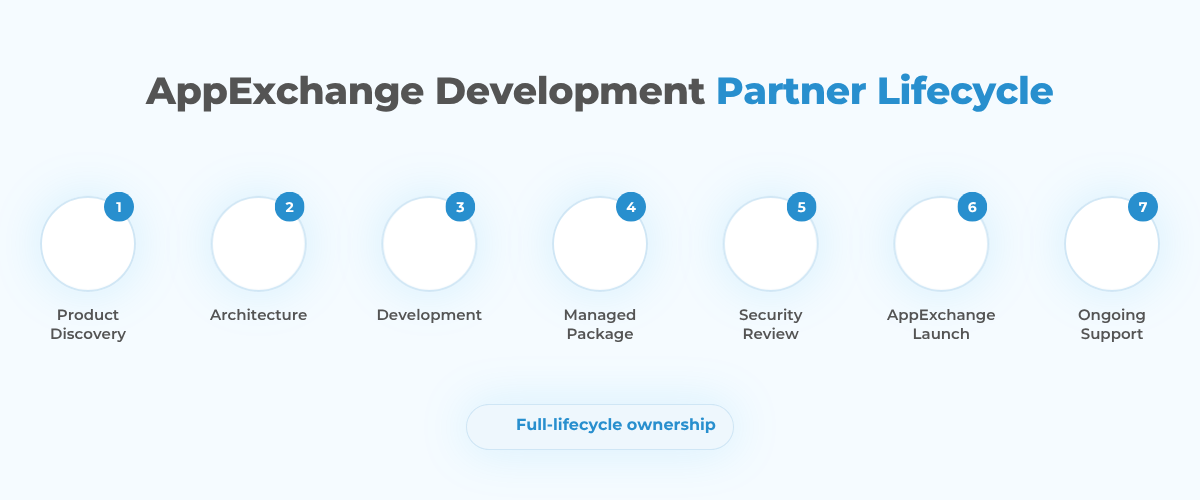
A Salesforce AppExchange development partner helps an ISV move from product concept to architecture, development, packaging, marketplace readiness, launch, and ongoing releases.
That scope is broader than a typical Salesforce implementation. A team configuring Sales Cloud for one company can optimize everything around one org. An AppExchange product team has to design software that can work across many subscriber orgs with different permissions, objects, data volumes, integrations, and existing customizations.
A strong partner should be able to support:
- Product discovery and architecture
- Apex and Lightning Web Components development
- Managed package architecture
- First- and second-generation packaging
- Salesforce APIs and external integrations
- Permission and access models
- Security Review preparation
- Automated testing and static analysis
- Licensing and trial setup
- CI/CD and release management
- AppExchange publishing
- Post-launch maintenance
Salesforce recognizes this specialization through its Product Development Outsourcer ecosystem, focused on partners that help companies design and develop commercial Salesforce products.
Why AppExchange Product Development Is Different
A managed package cannot be treated like an internal Salesforce feature.
An internal Flow, Apex class, or LWC can be changed whenever one company modifies its processes. A commercial package has to remain compatible with every customer that has installed it.
Architecture therefore has to account for:
- Different Salesforce editions and licenses
- Standard and custom objects
- Namespace and packaging restrictions
- Governor limits
- Customer sharing and permission models
- Upgrade compatibility
- API consumption
- External authentication
- Salesforce seasonal releases
- Security Review requirements
Packaging strategy is especially important. Salesforce’s guidance on second-generation packaging describes 2GP as a source-driven model that works naturally with Salesforce CLI, source control, automated builds, and modern CI/CD workflows.
A Salesforce AppExchange development partner should therefore understand Salesforce as a product platform, not simply as a CRM that needs customization.
1. Look for Real ISV and Managed Package Experience
The first question is simple: has this company actually built commercial Salesforce products?
Salesforce certifications are useful, but they are not the same as experience building a managed package that must be installed, upgraded, supported, and sold across multiple orgs.
Ask for examples involving:
- AppExchange-listed products
- Managed packages
- ISV customers
- Security Review
- Package upgrades
- Commercial integrations
- Subscriber support
For example, Peeklogic’s Salesforce development offering includes managed package development, AppExchange and ISV product development, Security Review preparation, integrations, CI/CD, and long-term product partnerships. The team has developed 6 AppExchange products of its own and 15+ products for clients, giving Peeklogic hands-on experience across the ISV lifecycle, from architecture and packaging to launch and continued product development. You can also review Peeklogic’s presence directly on Salesforce AppExchange.
2. Evaluate the Packaging Strategy Before Development Starts
Packaging decisions affect architecture, testing, release management, and future upgrades.
A potential partner should be able to explain:
- 1GP vs. 2GP
- Managed vs. unmanaged packages
- Namespace strategy
- Package dependencies
- Upgrade paths
- Metadata limitations
- Versioning
- Source control
For new products, ask whether the team recommends second-generation packaging and why. The important point is not that every product must use the same model, but that the decision is made deliberately.
A warning sign is a vendor that starts building immediately and plans to “package everything later.” Retrofitting the packaging architecture after the product becomes complex can create unnecessary technical debt.
3. Treat Salesforce Security Review as Part of Engineering
Security Review should influence development from the beginning rather than appearing as a checklist immediately before submission.
According to Salesforce Code Analyzer guidance for AppExchange partners, the submission process includes analyzing the package and providing the required reports as part of Security Review preparation.
The engineering team should consider:
- CRUD and FLS enforcement
- Injection vulnerabilities
- Cross-site scripting
- Secure authentication
- Data exposure
- Sharing behavior
- External endpoints
- API security
- Secrets and credentials
Security scope can also extend beyond Apex when the product communicates with external services or APIs.
Timing matters too. Salesforce partner materials provide planning ranges that can span several weeks depending on the solution and submission, so an ISV should build buffer into the launch schedule.
Ask a prospective partner how it prepares for Security Review, handles external integrations, and responds if Salesforce identifies an issue. Peeklogic has a first-attempt Security Review pass track record, covering preparation, submission, reviewer communication, and remediation when needed.
4. Review Architecture, Not Just the Feature List
ISV founders naturally think in features. A strong Salesforce product team also thinks about what happens when hundreds of customers install those features.
Architecture discussions should cover:
- Bulkification and governor limits
- Async processing
- Large data volumes
- Error logging and retry logic
- API limits
- Configuration vs. hard-coded behavior
- Customer extensibility
- Upgrade safety
This is especially important when Salesforce connects with an ERP, billing platform, document system, project management tool, or proprietary backend.
The product should define which system owns each piece of data, what happens when requests fail, how retries work, and how administrators diagnose problems without developer access.
A product that performs well in a clean demo org can still struggle in a heavily customized enterprise environment.
5. Ask About Licensing and Commercial Architecture
The way you sell the product can influence how it should be built.
Before development goes too far, discuss:
- Per-user vs. org-wide licensing
- Free vs. paid plans
- Trial access
- Feature-based editions
- Provisioning
- Installation tracking
- Upgrade entitlement
According to Salesforce’s License Management App documentation, the LMA helps partners track managed-package installations and licenses. Salesforce publishing workflows can also connect packages with pricing, trials, and licensing.
Your development agency does not need to define your pricing strategy, but it should understand how that strategy affects product architecture.
6. Evaluate CI/CD, Testing, and Release Management
Launching version 1.0 is the beginning of an AppExchange product lifecycle, not the end.
Salesforce changes continuously, your roadmap evolves, and new customers expose edge cases that were invisible during initial development.
Ask how the partner handles:
- Git and branching
- Automated deployments
- Package versioning
- Apex and LWC testing
- Regression testing
- Sandbox validation
- Release readiness
- Hotfixes and rollbacks
- Technical debt
The goal is to avoid a release process where every upgrade becomes another manual project.
Also ask what happens after launch. Does the agency offer maintenance? Can the same engineers support future versions? How are urgent production issues handled?
If nobody owns version 1.1, you have hired a project vendor rather than a long-term product partner.
7. Check Whether the Team Understands Product UX
A Salesforce application can be technically correct and still be frustrating to install or use.
AppExchange product UX includes more than attractive Lightning components. It also includes:
- Installation
- Permission assignment
- Authentication
- Initial setup
- Configuration screens
- Error handling
- Documentation
- Feature discovery
- Upgrade communication
A good product team designs for both the end user and the Salesforce admin.
If a customer needs a 40-page guide and several hours of developer help just to activate the app, that friction becomes part of the product itself.
8. Verify the Partner Outside Its Own Website
Do not evaluate an agency only through its own sales material.
Salesforce marketplace profiles provide another layer of validation through verified projects, reviews, certifications, competencies, and services.
For example, Peeklogic’s AppExchange consulting profile provides public information about its Salesforce expertise, projects, customer feedback, and AppExchange development experience.
When evaluating a Salesforce AppExchange development partner, compare:
- AppExchange profile
- Customer reviews
- Case studies
- Public products
- Technical content
- Certifications
- Actual ISV references
The story should be consistent across all of them.
A Practical AppExchange Partner Scorecard
A scoring framework can keep the selection process from becoming purely subjective.
| Area | What to Verify | Weight |
|---|---|---|
| ISV experience | Managed packages, commercial products | 20% |
| Architecture | Scalability, packaging, integrations | 15% |
| Security | Security Review experience | 15% |
| Engineering | Apex, LWC, APIs, testing | 15% |
| Product delivery | UX, requirements, roadmap | 10% |
| DevOps | CI/CD, release process | 10% |
| Licensing | Trials, LMA, provisioning | 5% |
| Support | Post-launch maintenance | 10% |
Certifications matter, but the highest certification count should not automatically win. Weight the criteria according to the product you are actually building.
When an Agency Is Not the Best Option
Not every ISV needs an external AppExchange development company.
| Option | Best fit | Main trade-off |
|---|---|---|
| AppExchange agency | Complex commercial product | External dependency |
| In-house team | Long-term Salesforce roadmap | Permanent headcount |
| Low-code/no-code | Simple native workflows | Limited flexibility |
Choose an agency when you need managed-package and Security Review expertise quickly or want one team accountable for architecture, development, QA, and launch.
Choose an in-house team when Salesforce is central to a long-term roadmap and the workload justifies permanent architects, developers, QA, and DevOps capacity.
Low-code or no-code can work when the product mainly automates straightforward native Salesforce workflows. Once the roadmap requires sophisticated packaging, complex integrations, proprietary logic, or advanced upgrade behavior, specialist engineering becomes more important.
Red Flags to Watch For
Be cautious if a potential Salesforce AppExchange development partner:
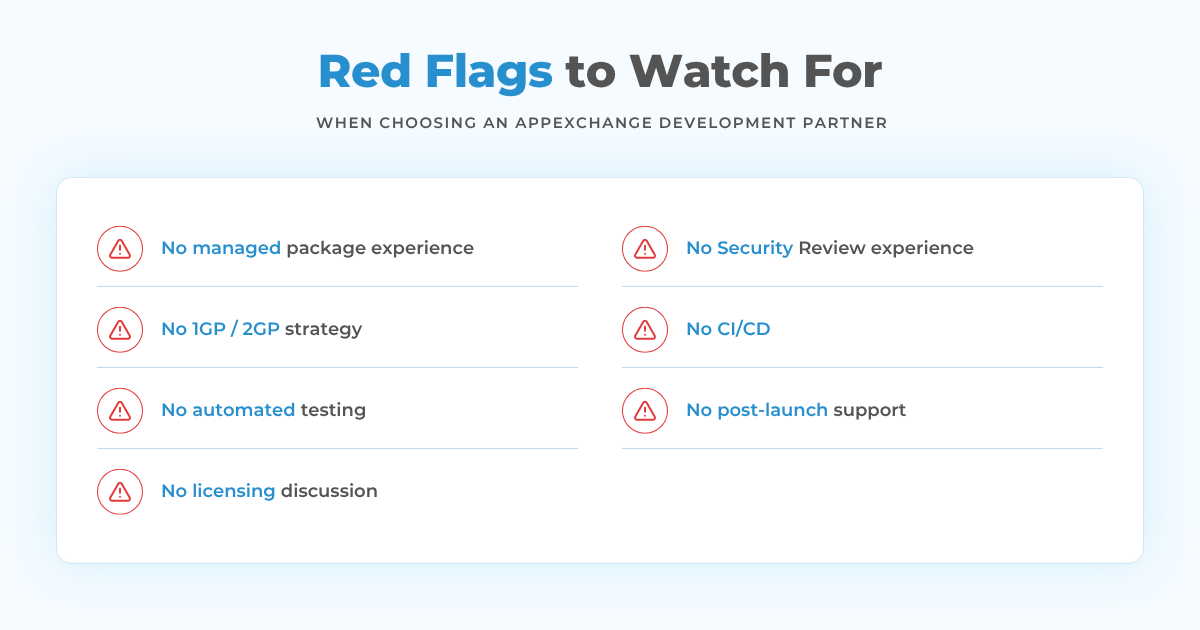
- Cannot show managed-package work
- Has never supported a Security Review
- Cannot explain its 1GP vs. 2GP recommendation
- Designs only for a clean demo org
- Has no CI/CD process
- Has no automated testing strategy
- Gives a fixed price before understanding architecture
- Never asks about licensing
- Has no post-launch support model
- Treats every requirement as custom Apex
The biggest warning sign is a team approaching your ISV application exactly like a standard Salesforce implementation.
Why Peeklogic Can Be Considered for ISV Product Development
Peeklogic operates as both a Salesforce development company and a product builder. The team has built and maintains six of its own products on AppExchange, giving it first-hand experience with the same packaging, publishing, Security Review, release, and marketplace requirements that ISV clients face.
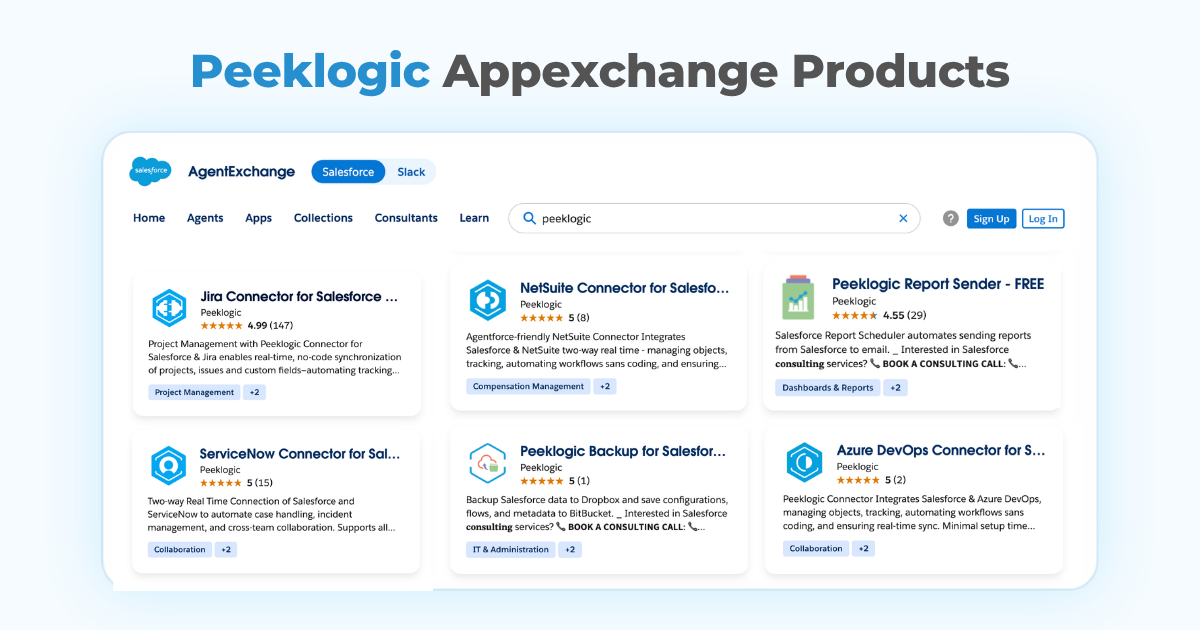
Through its Salesforce AppExchange Development Services, Peeklogic supports the full product lifecycle, from product ideation and architecture to development, managed packaging, Security Review, AppExchange launch, and post-launch growth.
The team also has a first-attempt Security Review pass track record and supports clients throughout the process, including preparation, submission, remediation if required, and communication around security requirements.
The engagement can continue after approval. Peeklogic also supports go-to-market strategy, including AppExchange listing preparation and optimization, product positioning, launch activities, and continued product growth.
There is also public delivery evidence. In the AppExchange document automation case study, Peeklogic worked on managed-package architecture, secure authentication, testing, documentation, and Security Review preparation.
For an ISV evaluating a development partner, this combination matters: experience building products for clients, maintaining six AppExchange products of its own, navigating Security Review, and supporting the journey from idea to go-to-market.
Want to Discuss Your AppExchange Product?
Schedule a ConsultationKey Takeaways
Choosing a Salesforce AppExchange development partner is a product decision, not simply a staffing decision.
Before signing, verify experience with:
- Managed packaging
- Security Review
- Scalable Salesforce architecture
- Apex, LWC, APIs, and integrations
- Licensing and provisioning
- CI/CD and testing
- AppExchange publishing
- Post-launch maintenance
The objective is not simply to get an app listed. It is to build a product customers can install, trust, upgrade, and continue using as both your roadmap and Salesforce evolve.
Frequently Asked Questions
A Salesforce AppExchange development partner helps ISVs design, build, package, secure, publish, and maintain commercial Salesforce applications. The scope can include architecture, Apex and LWC development, integrations, managed packages, Security Review, licensing, DevOps, and post-launch support.
An ISV develops and sells a software product built on or integrated with Salesforce. A consulting partner primarily provides implementation and professional services. Some Salesforce companies work in both areas, while Product Development Outsourcers specialize in building commercial products for ISVs.
Commercial Salesforce applications commonly use managed packaging because it supports controlled distribution, versioning, and upgrades across subscriber orgs. The right packaging strategy depends on the product architecture and should be decided early rather than after development is complete.
Salesforce partner materials provide different planning ranges depending on the submission and product, often spanning several weeks. Complex integrations, incomplete documentation, or identified security issues can extend the process.
Ask for examples of managed packages and published products, Security Review experience, packaging strategy, testing approach, CI/CD process, integration expertise, licensing knowledge, and post-launch maintenance. Also ask who will work on the product after the sales process is complete.
Yes. An experienced internal Salesforce product team can build and maintain an AppExchange application. An external partner becomes useful when you need specialized ISV expertise, additional engineering capacity, Security Review experience, or an end-to-end team without hiring permanent architects, developers, QA engineers, and DevOps specialists.

Accomplished Salesforce professional with a decade of hands-on expertise in designing, implementing, and optimizing Salesforce Service Cloud solutions for organizations across diverse industries. Adept at translating complex business needs into scalable, high-performance configurations and customizations that enhance customer service, streamline case management, and improve operational efficiency.