August 07, 2026
 29 Views
Top 6 CPQ Solutions for Salesforce in 2026


CPQ solutions for Salesforce are becoming increasingly important as companies look for better ways to automate product configuration, pricing, approvals, and quoting. According to Verified Market Research, the global Configure, Price, Quote software market is projected to reach USD 7.96 billion by 2032, growing at a compound annual growth rate of 16.5% from 2026 to 2032.
For Salesforce users, choosing a CPQ platform has become more complicated. Salesforce CPQ is now at the end of sale for new customers, although existing customers can continue using it. Salesforce is directing new product development toward Agentforce Revenue Management, its broader platform for pricing, quoting, contracts, orders, assets, billing, and related revenue processes.
Third-party platforms such as Conga, DealHub, and Nue offer different approaches to enterprise configuration, guided selling, subscriptions, usage, and billing. A custom Salesforce solution can also be the better option when a company’s commercial rules do not fit a standard product.
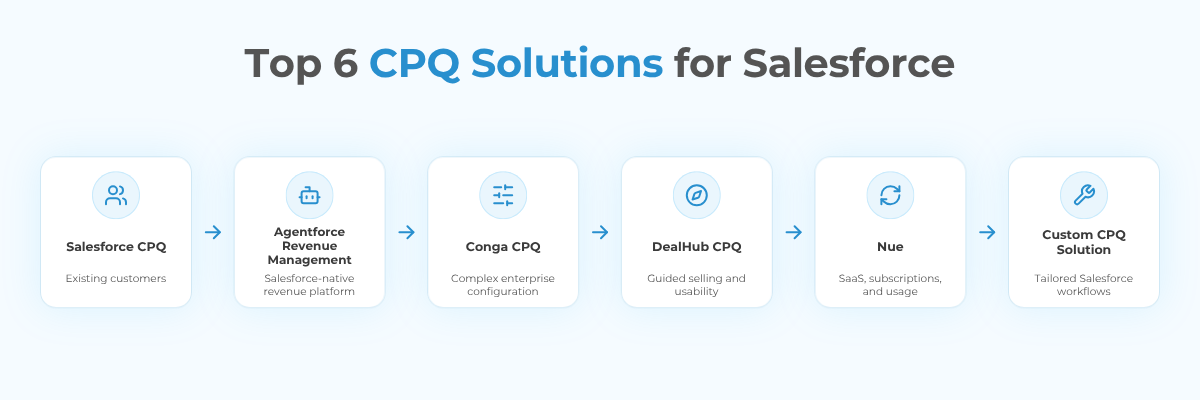
This guide compares six options:
- Salesforce CPQ
- Agentforce Revenue Management
- Conga CPQ
- DealHub CPQ
- Nue
- A custom CPQ solution built on Salesforce
What Is CPQ?
CPQ stands for Configure, Price, Quote. It helps sales teams select valid products, calculate the correct price, apply discount and approval rules, and generate an accurate customer proposal.
The process begins with configuration. A seller selects products, bundles, services, quantities, and compatible options. The pricing stage applies price books, discount schedules, contract terms, subscriptions, usage tiers, or customer-specific agreements. Finally, the quote is generated with the approved products, prices, and commercial terms.
Modern CPQ often extends beyond quote creation. It may connect Salesforce opportunities with contracts, orders, assets, renewals, subscriptions, billing, tax, and revenue reporting. Companies should therefore evaluate architecture and system ownership, not only the quoting interface.
What Is Salesforce CPQ?
The following Salesforce video provides a brief overview of the traditional Salesforce CPQ product:
CPQ Solutions for Salesforce at a Glance
| Solution | Best suited for | Salesforce integration | Main consideration |
|---|---|---|---|
| Salesforce CPQ | Existing Salesforce CPQ customers | Native managed package | End of sale for new customers |
| Agentforce Revenue Management | New Salesforce-first revenue projects | Built on Salesforce | Broader implementation scope |
| Conga CPQ | Complex products, pricing, and contracts | Salesforce and open-platform options | Greater configuration complexity |
| DealHub CPQ | Guided selling and seller usability | Integrated with Salesforce | Separate revenue platform |
| Nue | SaaS and AI companies with modern pricing | Salesforce-native CPQ | Focused on recurring and usage-based revenue |
| Custom Salesforce CPQ | Unique products, approvals, or integrations | Built around the existing Salesforce model | Requires ongoing technical ownership |
Need Help Implementing CPQ for Salesforce?
Book a Consultation1. Salesforce CPQ
Salesforce CPQ is the established managed-package solution used by many existing Salesforce customers. It supports product bundles, configuration rules, price rules, discount schedules, subscriptions, amendments, renewals, approvals, and quote document generation.
Salesforce has clarified that Salesforce CPQ is end of sale, not end of life. New licenses are no longer sold to new customers, but existing customers can continue using the product, add users, renew licenses, and receive support. New product investment is now focused on Agentforce Revenue Management.
Its main strengths include:
For organizations with a stable implementation, there is no automatic need to migrate. The main concern is long-term direction. Companies planning a major redesign should decide whether further customization of the existing package is still the right investment.
Moving to Agentforce Revenue Management is not a standard package update. It requires discovery, data mapping, redesign of pricing and product logic, integration review, and testing.
Best for: Existing Salesforce CPQ customers whose current implementation continues to support their revenue processes.
2. Agentforce Revenue Management
Agentforce Revenue Management, formerly Revenue Cloud, is Salesforce’s strategic platform for CPQ and the wider revenue lifecycle.
It connects product catalogs, pricing, quotes, contracts, orders, assets, amendments, renewals, usage, and billing within a newer Salesforce architecture. It can also support direct sales, partner portals, ecommerce, customer self-service, and API-driven experiences.
Key advantages include:
Its main advantage is that it is designed as more than a quote generator. Product and revenue data can support a connected quote-to-cash process across sales, finance, service, and operational teams.
That wider scope also increases implementation complexity. A project may involve redesigning product catalogs, pricing procedures, order management, billing, and downstream integrations. Existing Salesforce CPQ logic cannot simply be copied into the new platform.
Best for: New Salesforce-centered revenue projects and organizations modernizing a legacy quote-to-cash architecture.
3. Conga CPQ
Conga CPQ is designed for enterprise organizations with complex configuration, pricing, quoting, and contract requirements. It is especially relevant when products contain many dependencies, catalogs are large, or customer-specific pricing and margin controls are central to the sales process.
The platform is particularly strong in the following areas:
Conga is a strong fit when the business requires a structured enterprise solution rather than a lightweight quoting tool. It can support complex catalogs, asset-based ordering, renewals, and contract-driven sales processes.
That capability comes with greater implementation and administration effort. Product structures, pricing logic, contracts, and integrations must be designed carefully. Teams also need the skills to maintain the broader Conga layer alongside Salesforce and connected back-office systems.
Best for: Enterprises with complex catalogs, manufacturing or industrial configuration, negotiated pricing, and contract-heavy processes.
4. DealHub CPQ
DealHub combines CPQ with guided selling, contract management, subscription management, billing, and digital sales rooms.
Its Salesforce integration synchronizes customer and opportunity data while giving sellers a structured path through discovery, product selection, pricing, approvals, and proposal creation.
The platform is especially useful for teams that need:
DealHub can help improve seller adoption and reduce manual coordination between sales, finance, legal, and operations. It is attractive to companies that want a modern quoting experience and relatively fast implementation.
DealHub is still a separate revenue platform integrated with Salesforce. Organizations with deeply customized objects, managed packages, or proprietary automation should confirm how data and business logic will operate across the integration boundary.
Best for: B2B and SaaS sales organizations that prioritize guided selling, usability, and relatively fast implementation.
5. Nue
Nue is a quote-to-revenue platform created mainly for SaaS, AI, and other companies using recurring, usage-based, credit-based, or hybrid pricing.
Its CPQ and revenue lifecycle tools operate inside Salesforce, while the broader platform connects quoting with subscriptions, usage, billing, credits, and collections.
Nue is particularly relevant when the business needs to manage:
The platform is designed around lifecycle changes that are often difficult in traditional CPQ environments. This can make it a strong option for companies whose commercial terms change frequently after the initial sale.
Nue is less likely to be the right choice when the primary challenge involves physical-product engineering or highly specialized industrial configuration. Companies should also evaluate how it fits with existing ERP, billing, finance, and revenue-recognition systems.
Best for: SaaS and AI companies with subscription, usage, credit, billing, and customer lifecycle complexity.
6. A Custom CPQ Solution Built on Salesforce
A custom CPQ solution can be the better option when a commercial platform introduces more complexity than the business needs or cannot represent the company’s pricing and product rules accurately.
Instead of deploying a complete CPQ suite, the required functionality can be developed with Salesforce standard and custom objects, Apex, Lightning Web Components, Flow, approval processes, custom metadata, document generation, and integrations.
A custom solution may provide:
The goal is not to recreate every feature offered by a large enterprise CPQ platform. It is to build the specific capabilities that sales and operations teams actually require.
For example, a custom solution can guide users through a product configuration, calculate pricing from customer or contract data, route discounts for approval, generate a proposal, and send the completed quote to an ERP or billing platform.
A custom approach is most appropriate when the product catalog is manageable, pricing rules are specialized but clearly defined, quote data must trigger proprietary workflows, or existing Salesforce objects and automation must remain in place.
The trade-off is long-term ownership. The company becomes responsible for architecture, testing, releases, documentation, performance, security, and future enhancements.
Custom CPQ is not automatically the cheapest option. It is valuable when better workflow alignment and reduced platform overhead justify the development and maintenance effort.
Best for: Companies with specialized, clearly defined requirements that cannot be represented efficiently in an off-the-shelf product.
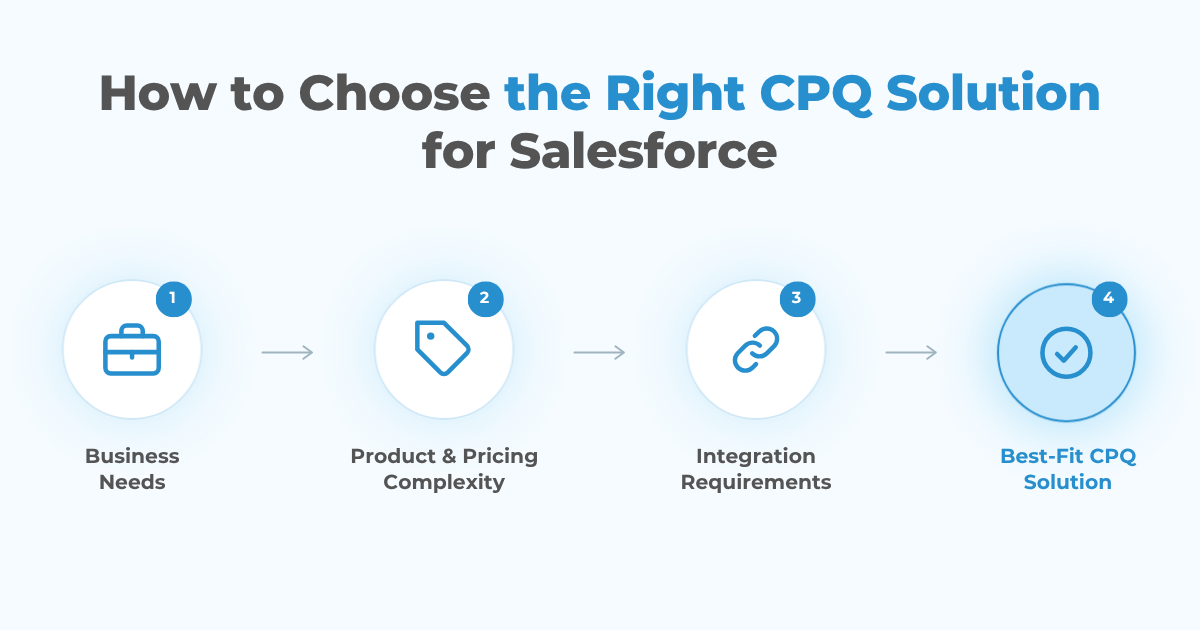
How to Choose the Right CPQ Solution for Salesforce
The best CPQ platform is not automatically the one with the longest feature list. It is the solution that supports the company’s revenue model without creating unnecessary operational complexity.
1. Review product and pricing complexity
Start with the product catalog. Simple products and bundles may not require an enterprise configuration engine. Industrial or engineer-to-order products may need multi-level dependencies and constraint-based logic.
Pricing requirements should also be documented clearly, including:
2. Define system ownership
Determine where products, prices, inventory, contracts, orders, billing, and customer data should live.
Salesforce may own some records, while ERP, billing, inventory, or product systems own others. These decisions define the integration architecture and help prevent duplicate or conflicting data.
3. Map the full revenue lifecycle
Quoting may only be the first stage. The selected solution may also need to support contracts, assets, amendments, renewals, usage, invoices, payments, and collections.
Selecting a CPQ tool without mapping these downstream processes often creates additional integration work later.
4. Evaluate the existing Salesforce environment
Custom objects, Apex, Flow automation, managed packages, portals, and integrations can significantly affect implementation effort.
A product that works well in a standard Salesforce organization may require extensive adaptation in a highly customized environment.
5. Plan for ownership after launch
The decision should include administrators, developers, implementation partners, vendor support, documentation, release management, and internal responsibilities.
Even a powerful CPQ platform can become difficult to maintain when no team clearly owns its configuration and improvement.
Which CPQ Solution Is Best?
There is no single best CPQ platform for every Salesforce organization.
Salesforce CPQ remains appropriate for existing customers with stable implementations.
Agentforce Revenue Management is Salesforce’s strategic option for new Salesforce-native revenue projects.
Conga CPQ is strong for enterprise configuration, pricing, and contract complexity.
DealHub CPQ suits teams prioritizing guided selling, seller experience, and implementation speed.
Nue is designed for subscription and usage-based companies.
Custom CPQ development offers the greatest control when requirements are specialized but do not justify a large commercial platform.
The final choice should follow a discovery process that maps products, pricing, approvals, contracts, orders, billing, integrations, reporting, and user roles before a platform is selected.
If you need external expertise to evaluate, implement, or customize your CPQ architecture, our guide to the best Salesforce consulting companies in the USA can help you compare experienced Salesforce partners.
Conclusion
The CPQ market is growing because pricing models and sales processes are becoming more complex. Companies need to manage subscriptions, usage, configurable products, partner selling, automated approvals, and renewals without losing control over margins or customer data.
For Salesforce users, the 2026 landscape creates an important architectural decision. Existing Salesforce CPQ customers can continue using the supported product, while new projects must evaluate Agentforce Revenue Management, third-party platforms, or a custom Salesforce solution.
The right option depends on how accurately it supports the company’s products, pricing models, sales channels, integrations, internal capabilities, and long-term revenue strategy.
Build a CPQ Architecture That Fits Your Business
Discuss Your ProjectFrequently Asked Questions About CPQ Solutions for Salesforce
No. Salesforce CPQ is end of sale for new customers. Existing customers can continue using the product, renew licenses, add users, and receive support. Salesforce has shifted new product investment toward Agentforce Revenue Management.
Revenue Cloud Advanced, within Agentforce Revenue Management, is positioned as the successor to Salesforce CPQ. It supports product catalogs, pricing, quoting, contracts, orders, assets, amendments, renewals, and other revenue processes.
No. It should be treated as an implementation project rather than a simple product update. Companies need to assess products, pricing rules, data, custom code, integrations, quote documents, subscriptions, and downstream processes.
Yes. Conga, DealHub, Nue, and other platforms can work with Salesforce customer, opportunity, product, quote, subscription, and contract data. The architecture and depth of the integration differ by platform.
Nue and DealHub are relevant options for subscriptions, amendments, renewals, usage, and billing. Agentforce Revenue Management is also appropriate when the company wants these processes closely connected to Salesforce.
A custom solution may be appropriate when pricing, configuration, approvals, or integrations are too specialized for a standard product, or when the required functionality is narrower than a complete commercial CPQ platform.

Accomplished Salesforce professional with a decade of hands-on expertise in designing, implementing, and optimizing Salesforce Service Cloud solutions for organizations across diverse industries. Adept at translating complex business needs into scalable, high-performance configurations and customizations that enhance customer service, streamline case management, and improve operational efficiency.