April 28, 2026
 684 Views
Salesforce ChatGPT Integration for Real Estate Professionals in 2026


Salesforce ChatGPT integration is no longer just about adding a chatbot to CRM. The real value starts when AI can work with the customer, property, deal, lease, and activity data your team already has in Salesforce.
OpenAI now offers a Salesforce plugin for ChatGPT that can bring CRM context into ChatGPT for tasks such as reviewing accounts and opportunities, preparing deal summaries, and drafting follow-ups. For real estate teams, that opens the door to faster client briefs, smarter follow-ups, property research, tenant support, and less time spent jumping between records and documents.
The challenge is making that access useful without giving AI too much freedom over sensitive business data. In this article, we’ll look at how Salesforce ChatGPT integration works in 2026, where it makes the most sense for real estate, and how to build it properly.
Want to Connect ChatGPT with Your Salesforce Data?
Talk to PeeklogicWhat Is Salesforce ChatGPT Integration?
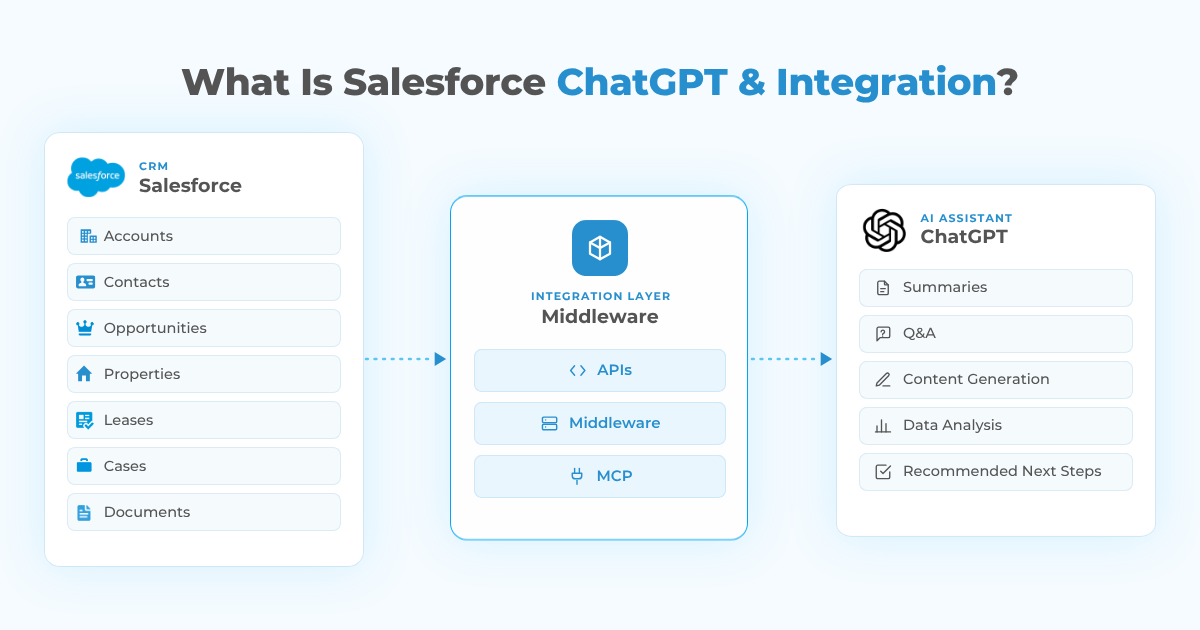
Salesforce ChatGPT integration connects Salesforce CRM data and workflows with ChatGPT so users can ask questions, generate content, summarize records, analyze context, or initiate approved actions using natural language.
The architecture can vary. ChatGPT may access Salesforce through a managed plugin. Developers can also connect the OpenAI API with Salesforce APIs or middleware, or keep business logic inside Salesforce and let ChatGPT invoke Agentforce capabilities through MCP.
The common idea behind Salesforce ChatGPT integration is grounding. ChatGPT becomes more useful when it works from trusted CRM context rather than a generic prompt.
For real estate, that context may include Accounts, Contacts, Leads, Opportunities, Properties, Listings, Leases, Cases, Tasks, documents, activity history, custom objects, and data from connected platforms.
Why ChatGPT Integration with Salesforce Matters for Real Estate
Real estate teams manage relationship-heavy information. A single transaction can involve buyers, tenants, landlords, investors, brokers, lenders, attorneys, property managers, contractors, and internal teams. Important context is often spread across CRM records, emails, notes, documents, calendars, and property systems.
ChatGPT integration with Salesforce can reduce the time users spend reconstructing that context manually.
Instead of opening an Account, several Opportunities, a lease record, recent Tasks, and email notes before a call, a user could request a concise account brief. Instead of writing a property follow-up from scratch, a broker could generate a draft based on the actual stage, requirements, and previous communication stored in Salesforce.
The value is not simply faster writing. It is faster access to relevant context.
This matters especially for companies using Salesforce for commercial real estate, property management, lending, development, or investment workflows where the CRM is customized around properties, deals, leases, and relationships.
Practical Real Estate Use Cases
1. Client and Deal Briefs
One of the most practical uses of Salesforce ChatGPT integration is meeting preparation.
A broker could request a summary containing current opportunities, recent activity, property interests, open service issues, upcoming lease events, and next steps.
For example: “Summarize the relationship with Acme Properties, including active deals, recent communication, decision-makers, risks, and anything I should know before tomorrow’s meeting.”
The response becomes much more useful when generated from CRM records than when the user manually explains the account to a generic chatbot.
2. Lead Qualification and Follow-Up
Real estate teams collect leads from websites, property portals, events, referrals, and campaigns. Salesforce can store the structured lead data, while ChatGPT helps turn that context into useful sales work.
Possible workflows include:
- Summarizing a new lead before assignment
- Drafting a personalized first response
- Extracting property requirements from notes or emails
- Suggesting follow-up questions when information is missing
- Preparing a handoff to a broker
- Converting call notes into structured CRM updates
AI should not make high-impact financial or legal qualification decisions without controlled business rules. It can, however, reduce manual work around collecting and organizing information.
3. Property and Opportunity Matching
A custom Salesforce environment may contain properties, listings, buyer requirements, tenant criteria, locations, budget ranges, lease terms, and historical activity.
A Salesforce ChatGPT integration can add a conversational layer over that information. A user might ask:
“Which active properties match this tenant’s size, location, budget, and move-in requirements?”
For precise recommendations, filters and eligibility rules should be handled programmatically rather than left entirely to the language model. ChatGPT can then explain the results, compare options, or create a client-ready summary.
4. Tenant and Property Management Support
Property management generates repetitive questions about maintenance, rent, access, policies, documents, and service requests.
Connected to the right Salesforce records, an AI assistant can summarize an existing Case, identify previous issues at the property, draft a response, or retrieve relevant knowledge before a service agent responds.
If a tenant reports another HVAC issue, for example, the assistant could summarize earlier cases, contractor visits, warranty notes, and current service status.
5. Document and Lease Intelligence
Real estate businesses rely on leases, amendments, property brochures, inspection reports, proposals, insurance documents, financing materials, and agreements.
A connected AI workflow can help users find, summarize, compare, or extract information from documents associated with Salesforce records. A broker might ask for key lease terms, while an investment team might compare two proposals.
The important design question is where documents are stored, who can access them, and whether the AI workflow is permitted to process that content.
6. Marketing and Property Content
ChatGPT can support content creation using structured Salesforce context.
Instead of asking for a generic property description, a workflow can provide approved property fields, amenities, location details, audience information, and brand guidance. The model can then draft listing copy, prospecting emails, follow-ups, social content, or internal summaries.
Human review remains important where pricing, availability, legal claims, or property characteristics are involved.
How Can ChatGPT Connect to Salesforce in 2026?
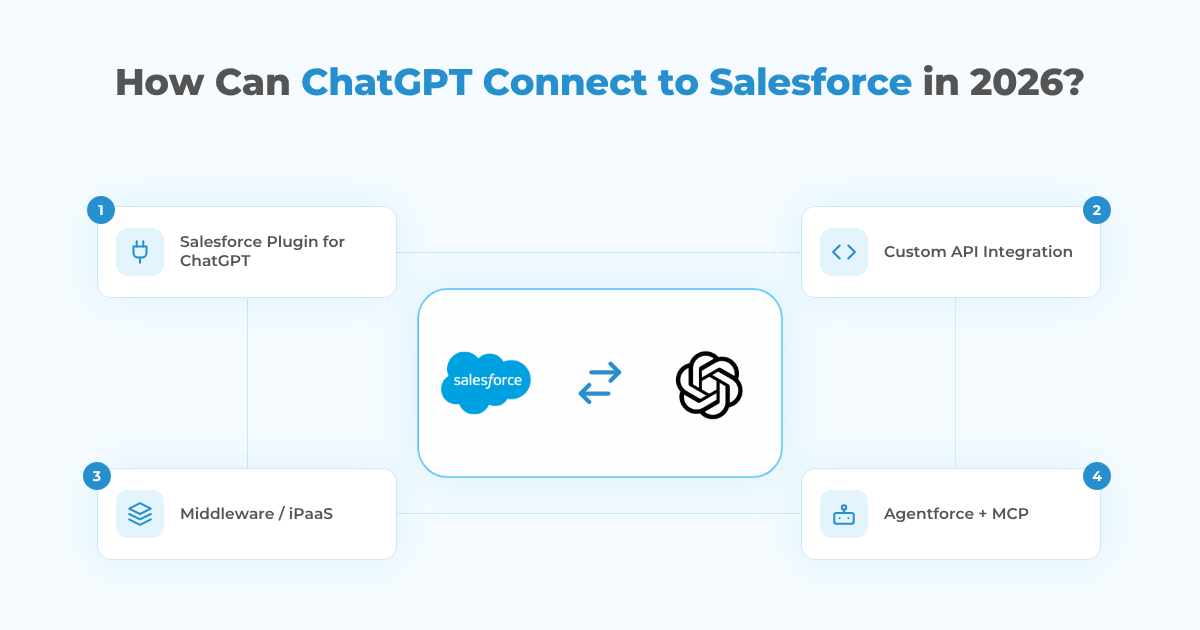
There is no single architecture for Salesforce and ChatGPT. The right setup depends on how much control the business needs, which Salesforce data should be available to AI, whether ChatGPT only reads information or can also trigger actions, and how many external systems are involved.
For some teams, a managed Salesforce plugin may be enough. Others may need a custom Salesforce ChatGPT integration using Salesforce APIs and the OpenAI API, middleware such as MuleSoft or Workato, or an architecture where ChatGPT interacts with Salesforce-native Agentforce capabilities. The best option is usually the one that gives users useful AI access without creating unnecessary complexity, security risk, or duplicate business logic.
Managed Salesforce Plugin for ChatGPT
OpenAI’s Salesforce plugin is designed to bring CRM context into ChatGPT. OpenAI describes use cases such as pulling account, opportunity, contact, and activity data, creating meeting briefs, reviewing pipeline risk, and preparing CRM updates.
For organizations whose needs fit the available capabilities and governance model, this can be the shortest path to value.
Custom OpenAI API and Salesforce API Integration
A custom integration gives the organization more control over which Salesforce records are retrieved, how prompts are built, which rules are applied, and what actions can be written back.
Salesforce APIs can expose approved CRM data to an integration service. The OpenAI API can generate or analyze content, while the integration layer validates the result before anything updates Salesforce.
This Salesforce ChatGPT integration model is useful when the company has custom real estate objects, proprietary matching logic, external property systems, or strict requirements around model access.
Middleware and iPaaS
MuleSoft, Workato, Boomi, or another integration platform may be useful when the workflow spans more than Salesforce and ChatGPT.
A property-management workflow might involve Salesforce, a property system, SharePoint, email, and accounting software. Middleware can centralize transformation, authentication, monitoring, and retries.
Agentforce and MCP
Salesforce now supports exposing Agentforce agents and Prompt Builder templates as MCP tools so external AI assistants such as ChatGPT can invoke Salesforce-native AI capabilities.
This is useful when Salesforce should retain domain-specific business logic while ChatGPT serves as the user-facing AI interface.
For example, ChatGPT could invoke an Agentforce action that retrieves approved property information, applies Salesforce permissions and workflow logic, and returns the result without recreating the whole process outside Salesforce.
What Data Should ChatGPT Be Allowed to Access?
More access does not automatically create a better Salesforce ChatGPT integration. A real estate company should define access by workflow.
| Data or Function | Example Use | Typical Control |
|---|---|---|
| Accounts and Contacts | Relationship summaries | Salesforce permissions |
| Opportunities / Deals | Pipeline and meeting briefs | Role and record access |
| Properties / Listings | Matching and comparison | Approved fields only |
| Leases | Term summaries | Restricted access |
| Cases | Tenant/service context | Service permissions |
| Documents | Search and summarization | File permissions |
| Financial data | Investment or account context | Strict role-based access |
| Record updates | Notes, tasks, next steps | Validation and approval |
A user should not gain access to Salesforce information through ChatGPT that they were not authorized to see in the source system.
Salesforce’s current developer architecture supports external client apps, OAuth-based access, and Agentforce APIs for controlled external communication. Authentication is only the first layer; the workflow still needs record-level permissions, field-level restrictions, auditability, and rules around write actions.
ChatGPT vs. Agentforce for Real Estate
If a company already uses Salesforce, why connect ChatGPT at all?
Agentforce is Salesforce-native and can be designed around Salesforce data, actions, permissions, Flow, and business processes. ChatGPT can be useful as a broader work interface that users already use across research, writing, documents, analysis, and other connected tools.
In some organizations, the tools will compete for the same workflow. In others, they can complement each other.
A company might keep sensitive actions inside Salesforce and expose selected Agentforce capabilities to ChatGPT. Another may prefer a custom OpenAI API integration because it combines Salesforce with several non-Salesforce systems.
Our guide to Salesforce multi-cloud implementation explains the same broader principle: AI works better when data ownership, integrations, and system boundaries are defined before another intelligence layer is added.
Common Salesforce ChatGPT Integration Risks
The biggest risk in Salesforce ChatGPT integration is not that ChatGPT writes a poor property description. It is that the integration acts on incomplete, unauthorized, or poorly governed business data.
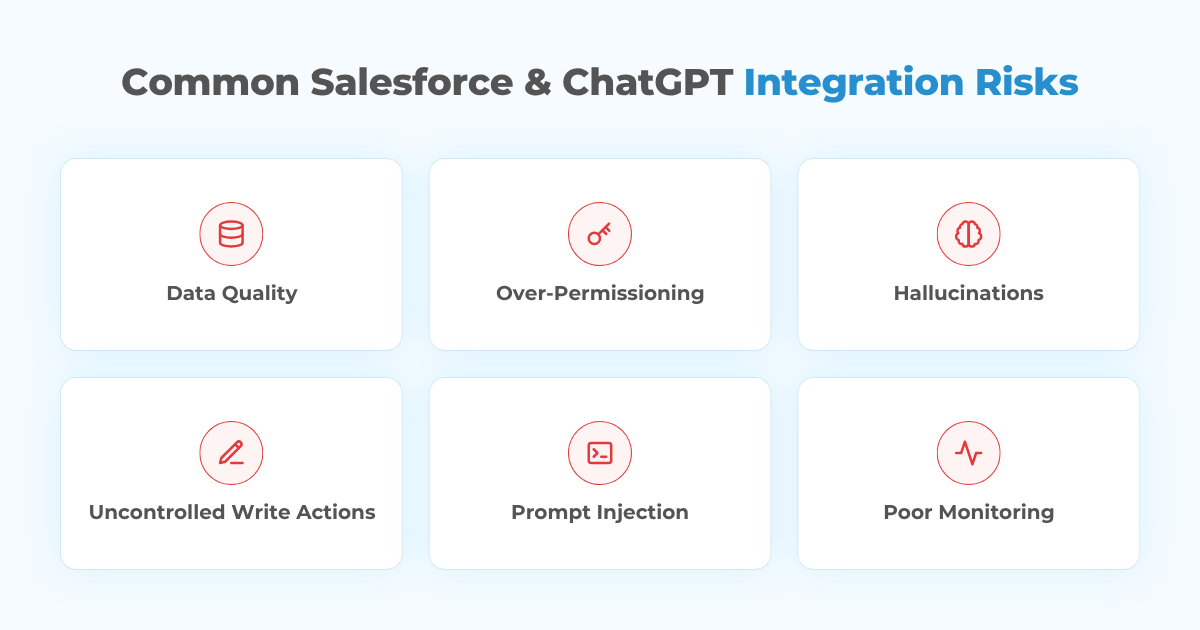
Data quality. Duplicate Contacts, stale listings, incomplete lease information, or inconsistent property fields will weaken AI results.
Over-permissioning. An assistant should not expose confidential investor data, tenant information, financial details, or documents simply because they exist in Salesforce.
Hallucination. A language model can still produce incorrect statements. Pricing, property availability, contract terms, investment returns, and compliance information should be grounded and validated.
Uncontrolled write actions. Creating a Task is low risk. Changing an Opportunity stage, modifying a lease record, or sending a client-facing message can have larger consequences and may require human approval.
Prompt injection and untrusted content. Emails, documents, and web content can contain instructions that should not override system rules. Integrations working with untrusted text need safeguards around tool use and sensitive data.
Poor monitoring. Teams need visibility into what AI accessed, generated, and changed.
Best Practices for Salesforce ChatGPT Integration
A reliable Salesforce ChatGPT integration should start with one workflow that has measurable value rather than placing AI over the entire CRM.
A good first use case is often read-heavy and low risk: account briefing, Case summarization, property comparison, document retrieval, or follow-up drafting.
☑️ Define the source of truth. ChatGPT should reason over Salesforce data, not silently invent missing CRM facts.
☑️ Keep business rules outside the prompt. Eligibility logic, permissions, pricing rules, and record matching should be enforced by Salesforce or the integration layer wherever possible.
☑️ Limit data access. Retrieve only the records and fields required for the task.
☑️ Separate read and write permissions. A user may be allowed to summarize an Opportunity without being allowed to change its stage.
☑️ Use human approval for high-impact actions. Client communications, financial updates, legal records, and important CRM changes need stricter control.
☑️ Test with real edge cases, including incomplete records, duplicate Contacts, stale property data, missing permissions, and unavailable external systems.
☑️ Measure business outcomes such as time saved, response time, CRM update quality, adoption, error rates, and conversion or service metrics.
How Peeklogic Approaches Salesforce ChatGPT Integration for Real Estate
Peeklogic approaches Salesforce ChatGPT integration as a data and workflow architecture problem first.
For a real estate company, discovery should identify where property, client, deal, lease, document, and service data lives; which Salesforce objects represent the business; which external systems participate; and which AI actions are safe to automate.
From there, the architecture can determine whether the best fit is the Salesforce plugin for ChatGPT, a custom OpenAI API integration, middleware, Agentforce, MCP, or a combination.
Through Peeklogic’s Salesforce custom integration services, implementation can include Salesforce APIs, custom objects, Apex, Flow, external systems, permissions, monitoring, and AI-specific integration logic. You can also review Peeklogic on Salesforce AppExchange for its Salesforce expertise and product presence.
The goal is not to add ChatGPT because AI is fashionable. It is to identify repetitive information work that slows brokers, property managers, sales teams, service teams, or investors down and gives them faster access to trusted business context without weakening data governance.
Planning a Salesforce ChatGPT Integration?
Talk to PeeklogicKey Takeaways
Salesforce ChatGPT integration has moved far beyond the chatbot experiments that defined the topic a few years ago.
In 2026, organizations can build Salesforce ChatGPT integration through managed plugins, custom APIs, middleware, and Salesforce-native Agentforce or MCP architectures.
For real estate, useful workflows include client and deal summaries, lead follow-up, property matching, tenant support, document intelligence, and content creation.
The best Salesforce ChatGPT integration works from trusted Salesforce data and defined business rules. Problems appear when an organization gives AI broad access to inconsistent data and expects the model to understand the business automatically.
Frequently Asked Questions
Salesforce ChatGPT integration connects Salesforce CRM data or workflows with ChatGPT so users can retrieve context, summarize information, generate content, analyze records, or initiate approved actions through natural language.
OpenAI currently offers a Salesforce plugin that can bring CRM context such as accounts, opportunities, contacts, and activity into ChatGPT. Organizations can also build Salesforce ChatGPT integration using Salesforce APIs, the OpenAI API, middleware, or Agentforce capabilities.
Common use cases include account and deal briefs, lead follow-up, property matching, tenant-support summaries, document search and summarization, CRM note generation, and marketing content based on approved property and customer data.
Salesforce ChatGPT integration can be designed securely, but security depends on the architecture. Teams should enforce authentication, Salesforce permissions, field and record access, data minimization, logging, and human approval for sensitive actions.
Agentforce is Salesforce-native and designed around Salesforce data, actions, permissions, and business workflows. ChatGPT is a broader AI work environment that can connect to Salesforce and other tools. Depending on the use case, companies may use one or combine both.
Not always. A managed plugin may cover some standard CRM use cases. Custom Salesforce ChatGPT integration becomes more valuable when the company uses specialized real estate objects, proprietary rules, external property systems, complex permissions, or controlled write-back workflows.


Salesforce Architect, CEO & Founder of Peeklogic. AppExchange Applications development, CRM Implementation, Integration with enterprise level software, Salesforce Data Migration. Salesforce AppExchange Applications development, CRM Implementation, Integration with enterprise level software, Salesforce Data Migration