
 August 18, 2026
 46 Views
6 Salesforce Jira Connectors, Compared by Setup Time, Sync, and Price


A Salesforce Jira connector synchronizes Salesforce records with Jira issues, reducing manual data entry and helping customer-facing and technical teams work with the same information. The available options differ in setup time, sync direction, pricing, and support for standard or custom Salesforce objects.
There are multiple ways Jira can be integrated with Salesforce, from dedicated apps to no-code sync tools and broader integration platforms. Here’s how the six options compare before we go into detail on each.
| Connector | Category | Sync direction | Setup time | Pricing / trial |
|---|---|---|---|---|
| Peeklogic | Dedicated app | Two-way | ~30 min | $3,600/10 users/year |
| Appfire | Dedicated app | Two-way | Not published | Free up to 10 |
| Exalate | No-code sync | Two-way | Not published | From $550/month |
| Unito | No-code sync | Two-way | No-code setup | Contact for pricing |
| Boomi | iPaaS platform | Configurable | Technical setup | Platform-based |
| Skyvia | No-code sync | Configurable | GUI setup | Free, 10K records/mo |
Different connectors in Market
Manual entry between Salesforce and Jira creates predictable problems: duplicate work, inconsistent data, slower escalations, and missed updates. A well-planned Salesforce integration can keep customer, sales, service, and project data aligned while engineering teams continue working in Jira.
The main difference is architecture. Dedicated apps focus specifically on Jira-Salesforce workflows, no-code platforms connect multiple systems, and iPaaS products provide a more comprehensive integration layer. Here’s a closer look at how each connector works.
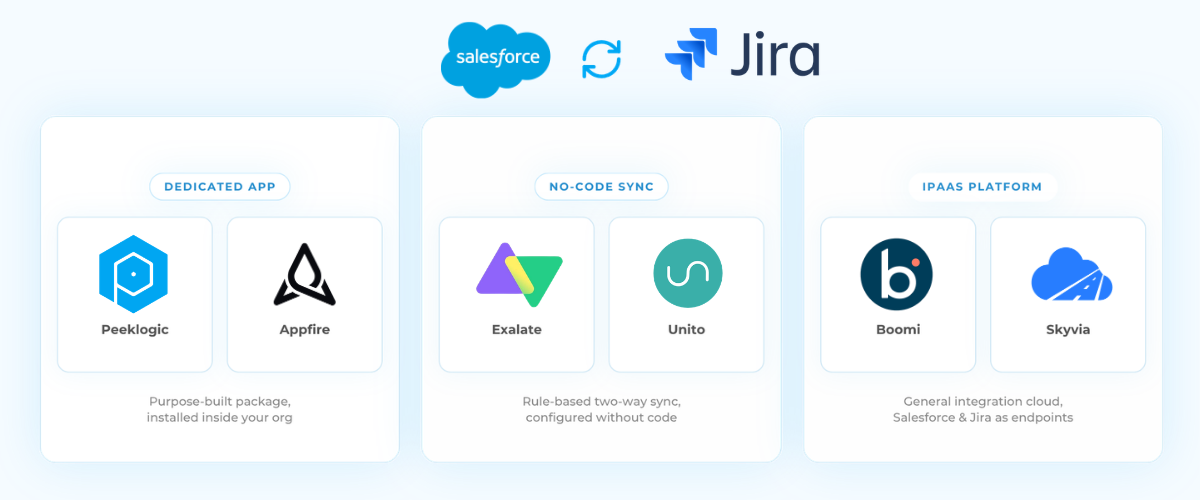
1. Peeklogic
Peeklogic Jira Connector for Salesforce is a dedicated Salesforce app for teams that want to integrate Jira and Salesforce while keeping much of the workflow within Salesforce.
It supports real-time bidirectional synchronization, standard and custom Salesforce objects, field mapping, comments, attachments, Salesforce Flow automation, Jira subtasks, linked issues, history, and watchers.
Because the app works natively with Salesforce and communicates directly with Atlassian, teams do not need a separate middleware platform for the core connection. Sales and service users can create, search, link, and update Jira issues without switching between platforms for routine work.
Features of Peeklogic include:
- Standard and custom Salesforce objects
- Bidirectional comments and attachments
- Salesforce Flow automation
- Jira issue search and linking
- Jira Service Management support
- Flexible field mapping and sync rules
Peeklogic reports a median setup time of around 30 minutes. Pricing is $3,600 USD for the first 10 users/year and includes a 30-day free trial.
Need Help with Your Salesforce and Jira Integration?
Contact Our Team2. Appfire
Appfire Connector for Salesforce & Jira is another dedicated solution focused specifically on the Jira-Salesforce connection.
It supports two-way data exchange, standard and custom Salesforce objects, and flexible relationships between Salesforce records and Jira issues. Teams can create Salesforce records from Jira, create Jira issues from Salesforce, and configure mappings for different object types.
One useful capability is support for one-to-many and many-to-many relationships. This can help when one Salesforce case, opportunity, or account needs to relate to several Jira issues.
Features include:
- Standard and custom Salesforce objects
- One-to-many and many-to-many relationships
- Advanced field mapping
- Record and issue creation across systems
- Automatic or manual synchronization
Appfire’s 2026 Cloud pricing is free for 1-10 users, $803/year for 25 users, $1,605/year for 50 users, and $3,210/year for 100 users. A 30-day free trial is available.
3. Exalate
Exalate is a synchronization platform for Jira, Salesforce, ServiceNow, Azure DevOps, and other systems.
Its main difference is that both sides can control their own sync rules. A Jira administrator can configure what Jira sends or accepts, while a Salesforce administrator manages the Salesforce side independently.
This model can work well when different departments, partners, or companies collaborate but should not share full administrative control over both platforms.
Exalate also supports advanced scripted configurations, queueing, and retry logic for more complex synchronization requirements.
Features include:
- Independent synchronization rules
- Granular field mapping
- Scripted configurations
- Multi-instance integrations
- Queueing and retry handling
Salesforce integrations require a Pro or Enterprise plan. Pro starts at $550/month, and a 30-day trial is available.
4. Unito
Unito’s Jira and Salesforce integration is a no-code synchronization platform rather than a dedicated Salesforce application.
It supports continuous two-way workflows across Salesforce, Jira, Azure DevOps, ServiceNow, and many other work-management platforms.
For Salesforce and Jira, teams can synchronize Leads, Contacts, Accounts, Opportunities, Cases, standard and custom objects, comments, attachments, and custom fields.
Admins can configure sync direction at the field level. For example, customer details may move from Salesforce to Jira while Jira status and resolution data sync back into Salesforce.
Unito can also preserve relationships and hierarchies, which is useful when Salesforce Accounts, Opportunities, or Cases need to relate to Jira epics, stories, tasks, or subtasks.
Features include:
- Field-level sync rules
- Standard and custom objects
- Comments and attachments
- Hierarchy and relationship sync
- Historical Salesforce records
Salesforce is a premium connector available on specific Unito Enterprise plans, so pricing is provided directly by Unito.
5. Boomi
Boomi is an iPaaS platform rather than a dedicated Salesforce Jira connector.
Its focus is broader enterprise integration. Salesforce and Jira can be connected alongside ERP systems, finance applications, APIs, databases, marketing platforms, and other services.
Boomi provides Jira REST and Salesforce connectors. Integration teams can configure connections, operations, data mappings, transformations, and process logic within a centralized integration architecture.
This provides more flexibility than a dedicated connector, but setup usually requires more technical involvement.
Boomi is particularly relevant when:
- Jira and Salesforce are only two of several connected systems
- Complex data transformation is required
- The company wants centralized integration orchestration
- An iPaaS strategy is already in place
Features include:
- Jira REST and Salesforce connectors
- Reusable integration components
- Data mapping and transformation
- Process orchestration
- API management
Boomi uses platform-based pricing. Its Pay-As-You-Go option starts at $99/month plus usage, with a 30-day free trial.
6. Skyvia
Skyvia Salesforce and Jira Integration provides a visual no-code approach to moving and synchronizing data between the platforms.
It supports both one-way integration and configurable bidirectional synchronization.
For one-way workflows, UPSERT functionality can update existing Salesforce or Jira records instead of creating duplicates. For two-way synchronization, Skyvia tracks changed records and applies updates during synchronization runs.
Teams configure integrations through a GUI, schedule them automatically or run them manually, and review completed operations through Run History.
Features include:
- One-way and two-way synchronization
- UPSERT duplicate protection
- Visual field mapping
- Mass updates and deletes
- Scheduled or manual execution
Skyvia’s free integration plan supports up to 10,000 records per month. Paid plans start at $79/month when billed annually.
Manual Integration Using APIs
A pre-built connector is not always the recommended solution. Custom development can make more sense when the Jira-Salesforce workflow involves proprietary business rules, unusual Salesforce objects, strict privacy requirements, or functionality that existing connectors cannot configure.
The trade-off is ownership. Custom development gives the company full control over authentication, mapping, APIs, automation, error handling, and release timing, but the internal team also has to maintain everything.
Common use cases include:
- Creating Jira issues directly from Salesforce
- Managing engineering escalation workflows
- Tracking sprint or user-story status within Salesforce
- Migrating archived Jira data into Salesforce
- Syncing Jira status changes back to Salesforce
- Supporting custom change requests across multiple systems
Jira Salesforce Integration Using REST API
A modern Jira-Salesforce API integration usually follows this process:
- Define which Salesforce objects and Jira issue types need to relate.
- Decide which system owns each field.
- Choose one-way or bidirectional synchronization.
- Configure secure authentication and API access.
- Build an Apex service layer or middleware process.
- Map Salesforce fields to Jira fields.
- Trigger create and update actions through Flow, Apex, or events.
- Add logging, retries, duplicate protection, and permission controls.
Salesforce Named Credentials can be used to store endpoint and authentication configuration instead of maintaining authentication details directly inside Apex. Jira Cloud REST APIs can then create, update, search, and retrieve issues.
A basic mapping could look like this:
| Salesforce Field | Jira Field |
|---|---|
Summary__c | Summary |
Description__c | Description |
Status__c | Status |
JiraIssueKey__c | Jira issue key |
IssueURL__c | Jira issue URL |
Permissions are another important part of the architecture. The integration user should only have access to the Salesforce and Jira operations required by the workflow.
A custom API solution provides maximum flexibility, including custom business rules that marketplace connectors may not cover. The downside is long-term responsibility for API changes, authentication, monitoring, testing, error handling, and maintenance.
Choosing Best Connector for Your Company
There is no universal best Salesforce Jira connector. The right option depends on your architecture, technical resources, integration scope, and who will configure and maintain the connection.
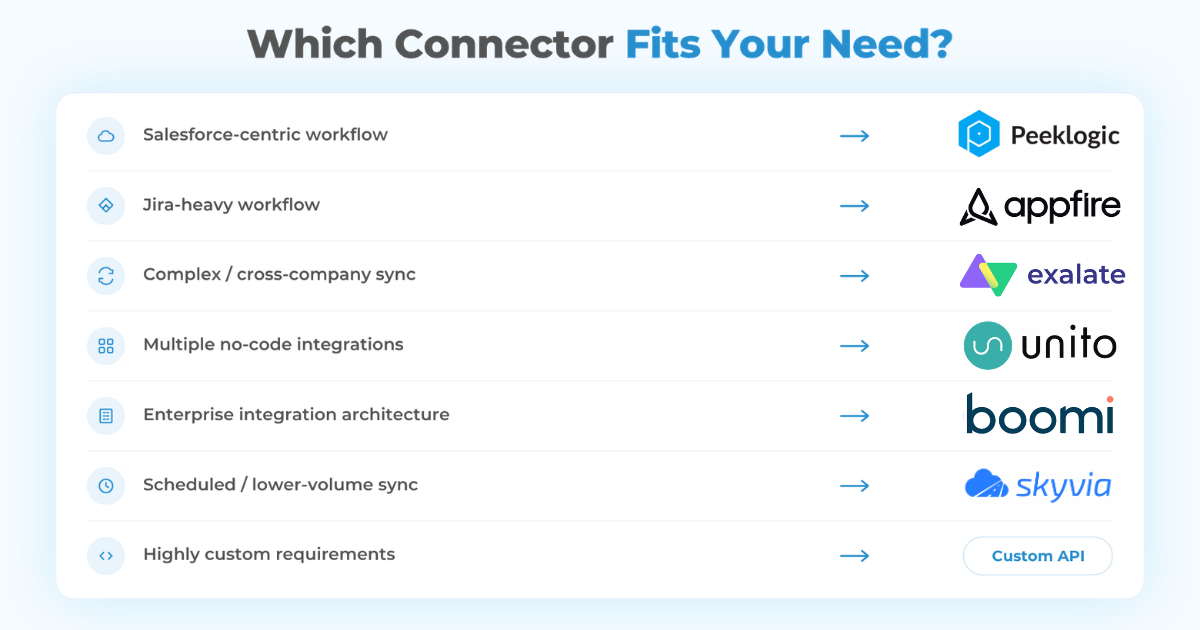
- Peeklogic fits Salesforce-centric teams that want a dedicated app, custom object support, Flow automation, and Jira functionality directly within Salesforce.
- Appfire works well for Jira-heavy environments that need flexible relationships between Jira issues and Salesforce records.
- Exalate suits independently managed or cross-company systems where both sides need granular control over sync rules.
- Unito works well when Jira and Salesforce are part of a broader no-code workflow involving multiple platforms.
- Boomi is better suited to enterprise architectures where Salesforce and Jira are only two endpoints among many.
- Skyvia is useful for teams looking for visual configuration, scheduled synchronization, and lower-volume integrations.
- Manual API integration fits highly customized requirements where the company has development resources to maintain the solution.
For teams specifically looking for a Salesforce-centered Jira connector rather than a general integration platform, Peeklogic is a strong option to evaluate. Its current functionality, pricing, license details, and trial are available on the Peeklogic Jira Connector on Salesforce AppExchange.
Want to Discuss Your Salesforce Jira Integration?
Schedule a MeetingKey Takeaways
There is no single Jira-Salesforce integration architecture that works for every organization.
A dedicated connector usually provides the shortest path for a focused Salesforce and Jira workflow. A no-code platform can work well when several collaboration systems need to synchronize. An iPaaS provides a broader integration layer across multiple systems, while custom API development gives the most control but also creates the greatest maintenance responsibility.
Before choosing a solution, clarify:
- Which Salesforce objects and Jira issues need to synchronize?
- Do updates need to sync back?
- Are comments and attachments required?
- Do you need standard and custom Salesforce objects?
- Who will configure and maintain the integration?
- Are Jira and Salesforce the only systems involved?
- What privacy and audit requirements apply?
- How predictable does the licensing model need to be?
Once these requirements are clear, choosing between a dedicated app, no-code platform, iPaaS, and custom development becomes much easier.
Frequently Asked Questions
A Salesforce Jira connector links Salesforce records with Jira issues so data can move between both systems automatically. Common use cases include creating Jira issues from Salesforce Cases, synchronizing statuses and fields, sharing comments and attachments, and tracking engineering escalations.
Yes. Several tools in this comparison support bidirectional synchronization, including Peeklogic, Appfire, Exalate, Unito, and Skyvia. The exact Salesforce objects, Jira fields, synchronization frequency, and configuration options depend on the product.
Yes. Dedicated connectors such as Peeklogic and Appfire allow teams to create Jira issues from Salesforce. This lets sales or service teams escalate work to engineering without leaving their Salesforce workflow.
Peeklogic and Appfire support standard and custom Salesforce objects. Unito also supports standard and custom Salesforce objects and custom field mapping. Other solutions can provide additional flexibility through configurable mappings or custom integration logic.
No. MuleSoft can make sense as part of a larger enterprise API and integration strategy, but it is not required to connect Jira and Salesforce. Companies can use a dedicated connector, a no-code synchronization platform, an iPaaS such as Boomi, or direct API development.
It depends on the requirements. Custom development provides complete control over business logic and data flows, but the company must maintain authentication, APIs, monitoring, retries, security, testing, and future platform changes. A managed connector can reduce that maintenance burden for more common Jira-Salesforce workflows.

Accomplished Salesforce professional with a decade of experience in designing, developing, and managing robust integrations between Salesforce and enterprise systems, ensuring seamless data flow, operational efficiency, and enhanced business capabilities. Skilled in bridging complex technical requirements with practical business solutions to deliver secure, scalable, and high-performing integration architectures.
